

Short answer: Polymarket vs Kalshi fees depend on which Polymarket you use and which market you trade. For 100 contracts at 50¢, Kalshi’s standard taker fee is $1.75, while Polymarket.com now charges $0.25 or $1.25 on most categories (and $0 on geopolitics) after its November 20, 2026 fee change. On the separate Polymarket US exchange, a typical retail taker often pays more than Kalshi until a higher volume tier applies.
The figures below come from official Polymarket and Kalshi fee pages fetched on November 24, 2026. Both platforms can change rates, and some markets use a different multiplier, so confirm the fee on the order ticket before you trade. This is a fee comparison, not financial or legal advice.
There are two Polymarkets
A fair comparison has to name the platform correctly. They are not the same schedule:
- Polymarket.com is the global market documented at docs.polymarket.com/trading/fees. Its latest taker rates took effect on November 20, 2026 at 23:59 UTC (the evening of November 20 in US Eastern Time), according to Polymarket’s predictions changelog.
- Polymarket US is a separate US exchange with its own fee schedule, in effect since 12:00 AM ET on November 14, 2026. A 70% taker rebate for API trades, not app trades, started at 12:01 AM ET on November 21, 2026 and runs through December 31, 2026.
- Kalshi is a CFTC-regulated US event-contract exchange. Its standard formula and 100-contract table are in the official fee schedule PDF dated July 7, 2026. Use the live fee schedule page for series-specific multipliers.
Access depends on where you live and on each company’s rules. This article compares published fees only; it is not legal advice.
How the fees are calculated
All three schedules use the same shape: the fee peaks near 50¢ and shrinks toward 1¢ or 99¢. You pay more when the outcome is most uncertain.
- Kalshi (most markets, taker): fees = round up(M × 0.07 × C × P × (1 − P)), where C is the number of contracts, P is the price in dollars, and M defaults to 1.
- Polymarket.com (taker only): fee = C × feeRate × p × (1 − p). The rate is 0.01 or 0.05 by category, and 0 for geopolitics. Makers are never charged a platform trading fee.
- Polymarket US (taker): Fee = Θ × C × p × (1 − p). Theta is 0.095, 0.085, 0.075 or 0.0695, based on trailing 30-day taker volume.
What 100 contracts at 50¢ cost
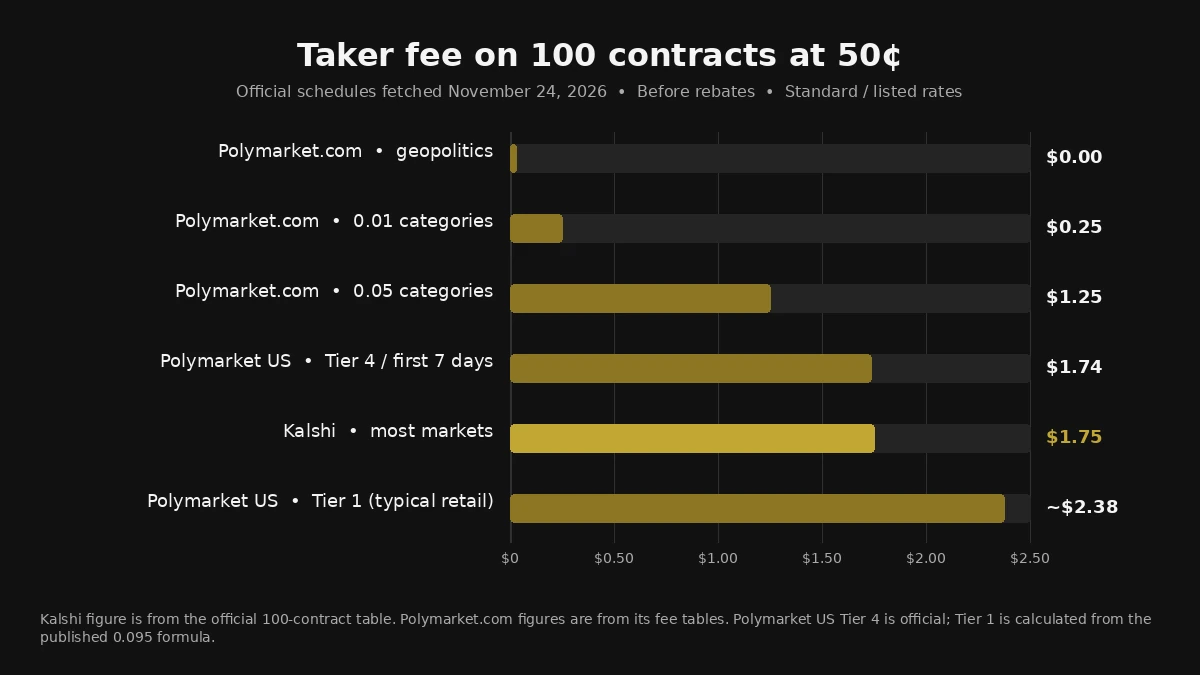
These are taker fees on a $50 position, before any rebate, using official tables where they exist. The Polymarket US Tier 1 figure is calculated from the published 0.095 formula (0.095 × 100 × 0.50 × 0.50 = $2.375, which rounds to $2.38 under the exchange’s nearest-cent rule).
| Platform | Taker fee (100 contracts at 50¢) | Maker trading fee on the same trade |
|---|---|---|
| Polymarket.com, geopolitics | $0.00 | $0.00 |
| Polymarket.com, 0.01 categories | $0.25 | $0.00 |
| Polymarket.com, 0.05 categories | $1.25 | $0.00 |
| Polymarket US, Tier 4, or days 1–7 for new accounts | $1.74 | No taker-style fee; makers can earn a rebate |
| Kalshi, most markets (M = 1) | $1.75 | $0.00 on most markets; some series charge makers |
| Polymarket US, Tier 1 (under $10,000 in 30-day taker volume) | About $2.38 | No taker-style fee; makers can earn a rebate |
Polymarket.com rates after the November 2026 change
Official category rates now are:
| Category | Taker fee rate | Fee on 100 shares at 50¢ |
|---|---|---|
| Crypto, except BTC 5-minute and 15-minute up/down | 0.01 | $0.25 |
| Politics excluding elections and geopolitics; economics; culture; weather; mentions | 0.01 | $0.25 |
| BTC 5-minute and 15-minute up/down; sports, including NFL and college football; finance; tech; election politics; combos; other / general | 0.05 | $1.25 |
| Geopolitics | 0 | $0.00 |
Every combo uses the 0.05 combos rate, even if its underlying markets would have been cheaper. Fees are rounded to five decimal places, and amounts smaller than 0.00001 USDC can round to zero on tiny trades near the extremes.
How to estimate your own fee
- Confirm which platform you are on: Kalshi, Polymarket.com or Polymarket US.
- Note whether your order will take liquidity or rest on the book as a maker order.
- Read the category or series. On Polymarket.com, that sets 0, 0.01 or 0.05. On Kalshi, check the multiplier and whether a maker fee applies.
- Write down C (contracts or shares) and p (price as a decimal, so 20¢ is 0.20).
- Multiply: coefficient × C × p × (1 − p).
- Apply rounding, then check the ticket. Kalshi’s official one-contract table shows $0.02 at 50¢ because it rounds the fee plus the position cost to a tenth of a cent (0.07 × 0.25 = 0.0175). Polymarket US rounds to the nearest cent with banker’s rounding.
At 20¢, the fee is lower. For 100 contracts, Kalshi’s official table lists $1.12. Polymarket.com charges $0.80 at a 0.05 rate and $0.16 at a 0.01 rate. Polymarket US is about $1.52 at Tier 1 and about $1.11 at the 0.0695 coefficient, before any rebate.
Makers, rebates and special cases
- Polymarket.com makers pay no platform trading fee. Daily pUSD maker rebates start at $200,000 in 30-day maker weighted volume; combos and fee-free trades do not qualify, according to the Maker Rebates Program.
- Polymarket.com taker rebates also start at $200,000 in 30-day weighted volume (Gold, 10%). Casual traders should assume a 0% rebate. See the Taker Rebate Program.
- Kalshi charges takers on immediately matched orders. Resting orders usually pay nothing, because the maker multiplier defaults to 0, but some series charge a maker fee when the order fills: fees = round up(M × 0.0175 × C × P × (1 − P)). Canceling is free. Combos (except uncorrelated NFL combos) list maker fees at 50% of the taker fee on the live schedule.
- Polymarket US new accounts get a 0.0695 taker coefficient for seven calendar days after the first fill. From day 8, a low-volume account can move to the 0.095 Tier 1 rate.
- The Polymarket US API rebate (70% back on the 0.0695 coefficient, through December 31, 2026) applies to API taker trades, not app trades. After that rebate, 100 contracts at 50¢ would be about $0.52, not the default app price.
- Kalshi perpetual futures use a separate basis-point schedule in the same official PDF, not the event-contract table above.
Deposit and withdrawal fees
- Kalshi: ACH deposits and withdrawals have no fee, wire deposits have no extra Kalshi fee, and card deposits have a maximum fee of 2%. Crypto transfers may include a processor fee, shown before you confirm. There is no settlement or membership fee. The transfers FAQ lists a $10 minimum deposit ($1,000 for wires). Our guide to Kalshi crypto deposits covers announced assets and networks.
- Polymarket.com: Polymarket charges no platform fee to deposit or withdraw USDC, though intermediaries such as Coinbase or MoonPay may, and a cross-chain move can include gas and a bridge fee. Send only a supported asset on the supported network; the same habit is in our Dogecoin wallet for gambling guide.
- Polymarket US: the withdrawal overview describes cash withdrawals as free, to the original funding method. The debit-card and ACH deposit pages we checked on November 24, 2026 list limits and timing but not a deposit fee, so confirm the amount on the deposit screen.
A 2% card deposit can outweigh a small trading-fee gap, so a no-fee ACH transfer is usually the cleaner starting point on Kalshi for US bank users.
Fee checklist before you place the trade
- Confirm whether you are on Kalshi, Polymarket.com or Polymarket US.
- Read the category or series on the ticket, including any Kalshi multiplier or maker fee.
- Decide whether you are taking liquidity or resting on the book.
- Do not count on a rebate unless you already meet the published volume threshold.
- Add funding costs: ACH, card, wire, crypto processor or bridge/gas.
- On Polymarket.com, remember that combos use the 0.05 rate even if the legs would have been 0.01 or free.
- These platforms trade event contracts in dollars (or pUSD), not Dogecoin. For casino deposit and withdrawal costs, see Dogecoin vs Bitcoin for gambling.
So which is cheaper?
- If you trade on Polymarket.com, you will usually pay less than Kalshi on a standard taker fill, and nothing on geopolitics. Limit orders that rest on the book pay no platform trading fee.
- If you are comparing Kalshi with the Polymarket US app as a typical retail user, Kalshi is usually cheaper after the first week ($1.75 versus about $2.38 on 100 contracts at 50¢). At Tier 4, or during the first seven days, both are about $1.75.
- Funding can flip a close comparison. A no-fee ACH transfer into Kalshi, or a no-platform-fee USDC move into Polymarket.com, can matter more than a few cents of trading fee on a small ticket.
This site has no affiliate relationship with Kalshi or Polymarket. Always use the fee shown on the ticket, because official schedules change.
Frequently asked questions
Are Kalshi fees higher than Polymarket?
On Polymarket.com, usually yes. 100 contracts at 50¢ cost $1.75 on Kalshi versus $0.25 or $1.25 on Polymarket.com, or $0 on geopolitics. On Polymarket US, a typical retail taker often pays more than Kalshi. Always check which Polymarket platform you are on.
How much does Polymarket charge in fees?
On Polymarket.com, only takers pay. The fee is shares × rate × price × (1 − price), with a rate of 0.01 or 0.05 by category; geopolitics is free. On Polymarket US, the taker coefficient ranges from 0.095 down to 0.0695 based on 30-day volume.
Is it better to use Kalshi or Polymarket?
It depends on access and the market. Polymarket.com is usually cheaper to trade. For many US app users, Kalshi is cheaper than Polymarket US on standard contracts, except during Polymarket US’s first-week 0.0695 rate or at high volume tiers. This is not legal or financial advice.
Do Polymarket or Kalshi charge withdrawal fees?
Polymarket.com charges no platform fee to deposit or withdraw USDC, though a bridge or exchange may. Polymarket US describes withdrawals as free. Kalshi charges no ACH withdrawal fee; crypto withdrawals may include a payment-processor fee.
Do limit orders avoid trading fees?
On Polymarket.com, makers are never charged a platform trading fee. On Kalshi, a resting order usually pays nothing, but some series charge a maker fee when it fills. Canceling a resting Kalshi order is free.
Trade and play responsibly
Prediction markets involve real money and real risk, and you can lose the amount you put in, plus fees. You must be 18 or older, or the higher legal age where you live. Only take part where it is legal for you, never use money you need for bills, and treat this as entertainment, not income. If trading or gambling stops being fun, take a break and reach out to an organisation such as Gamblers Anonymous or call 1-800-GAMBLER in the US.