
Short answer: Dogecoin dice is a crypto casino game where you bet DOGE on whether a random roll between 0 and 100 lands over or under a number you pick. The lower your win chance, the higher the payout, but the house edge (1% on Stake’s Dice) is built into every multiplier, so no setting or betting system beats it over time. At provably fair casinos you can check each roll yourself after you rotate your seeds.
This guide explains the maths in plain numbers, walks through a real verification, shows what betting systems actually do to your risk, and lists casinos that confirm both Dogecoin and dice on their own pages.
How Dogecoin dice works
Crypto dice isn’t a six-sided cube. It’s a random number on a scale, usually 0.00 to 100.00. You set three things:
- Bet size in DOGE.
- A target number, for example 50.50.
- A direction: roll over or roll under the target.
Together, the target and direction set your win chance, and the game shows the multiplier before you click roll. Stake’s Dice page (archived October 24, 2026, because Stake blocks automated visits) describes “a 100-sided virtual die” with outcomes from 0 to 100. Bitcasino’s provably fair guide says its Dice draws a whole number from 0 to 10,000 and divides it by 100, giving a roll from 0.00 to 100.00.
The coin doesn’t change the game. A roll funded with DOGE uses the same logic as one funded with BTC. Dogecoin matters at the cashier, where its one-minute block target and small fees suit frequent small deposits. We compare the two coins in Dogecoin vs Bitcoin for gambling.
The odds: where the house edge hides
Every dice multiplier follows one rule:
Multiplier = (100 − house edge) ÷ win chance
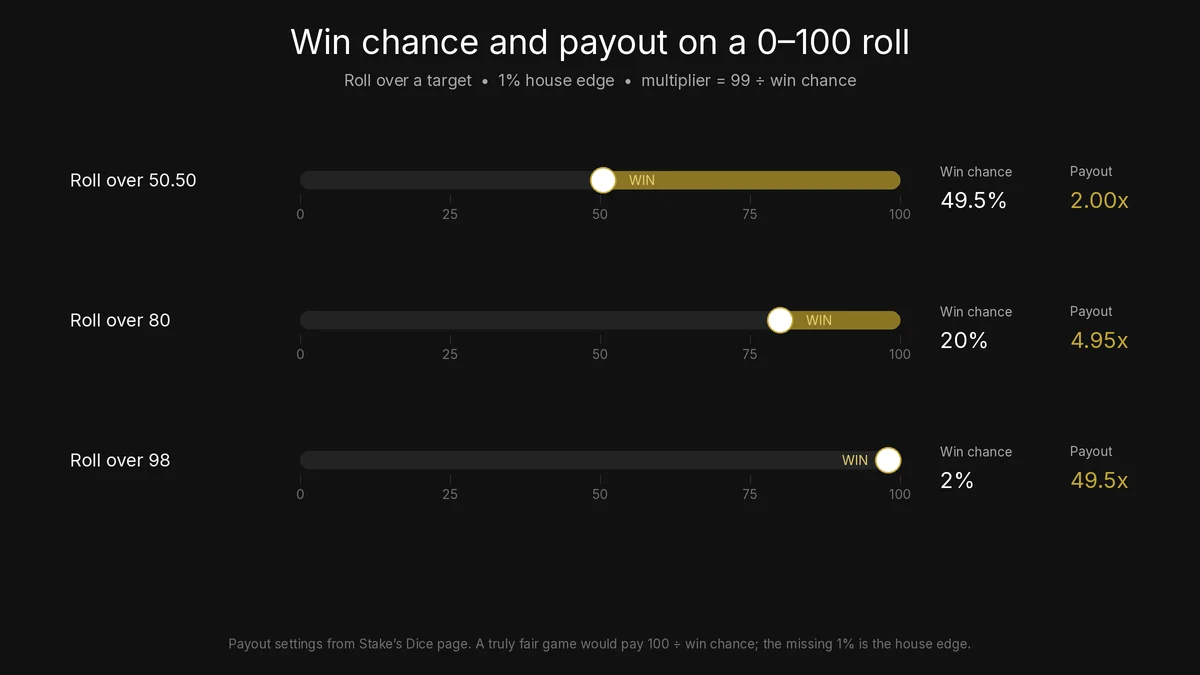
With a 1% edge, that’s 99 divided by your win chance. Stake’s Dice page lists a 99% return to player (RTP) with a 1% house edge, and gives these examples:
- 49.5% win chance pays 2x (roll over 50.50).
- 20% win chance pays 4.95x (roll over 80).
- 2% win chance pays 49.5x (roll over 98).
Multiply any chance by its payout and you get 99%. A truly fair game would pay 100%. The missing 1% is the casino’s margin, and it’s the same at every setting. Stake’s page says these RTP values “stay consistent across setups.”
What 1% means in DOGE
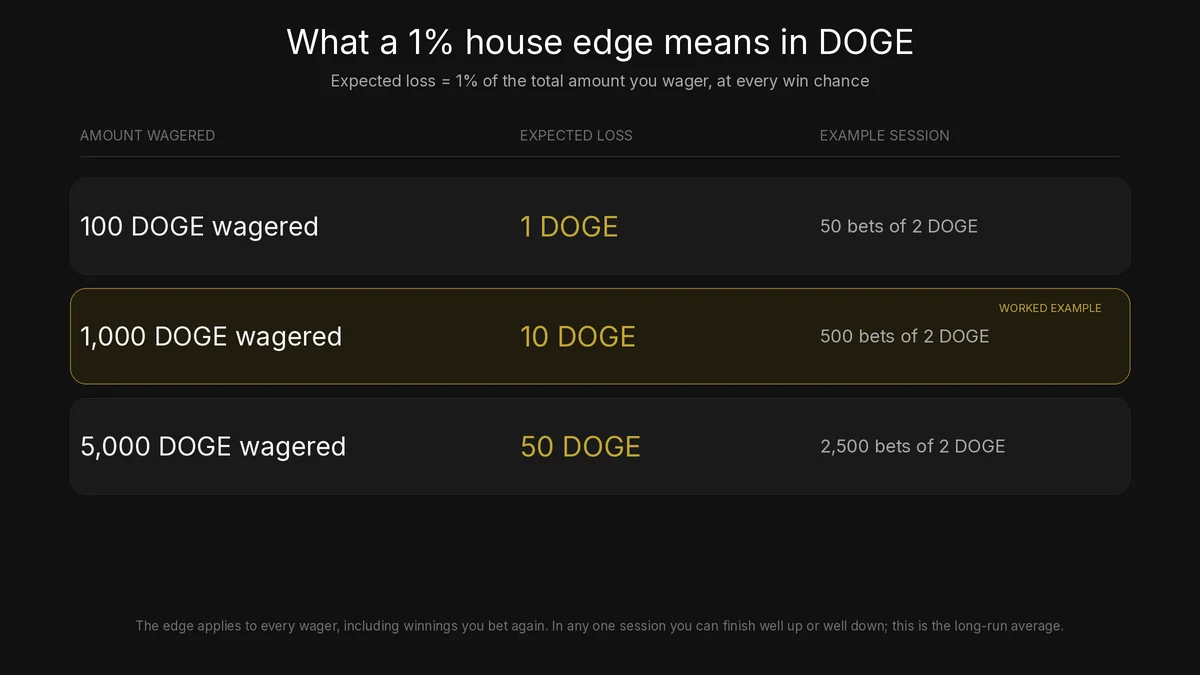
The edge applies to the total amount you wager, not to your deposit. If you place 500 bets of 2 DOGE, you’ve wagered 1,000 DOGE, and your expected loss is about 10 DOGE, whatever win chance you chose. Winnings you bet again count as new wagers too. That’s why fast auto-bet sessions can burn through a balance even when each bet looks small.
Expected loss is an average over many bets. In one session you can finish well up or well down. The edge only says where the results drift.
Do Dogecoin dice strategies work?
No strategy changes the house edge. Stake’s own Dice page says strategies “can’t guarantee a win, but they can help you control your bankroll.” Betting systems only reshape how your wins and losses arrive.
- Martingale doubles the bet after each loss so one win recovers everything. It produces many small wins and rare, huge losses.
- D’Alembert raises the bet by one unit after a loss and lowers it after a win. The swings are milder, but the edge is still there.
- Paroli raises the bet after wins to ride a streak, then resets. It risks your winnings instead of your losses.
Why Martingale goes bust
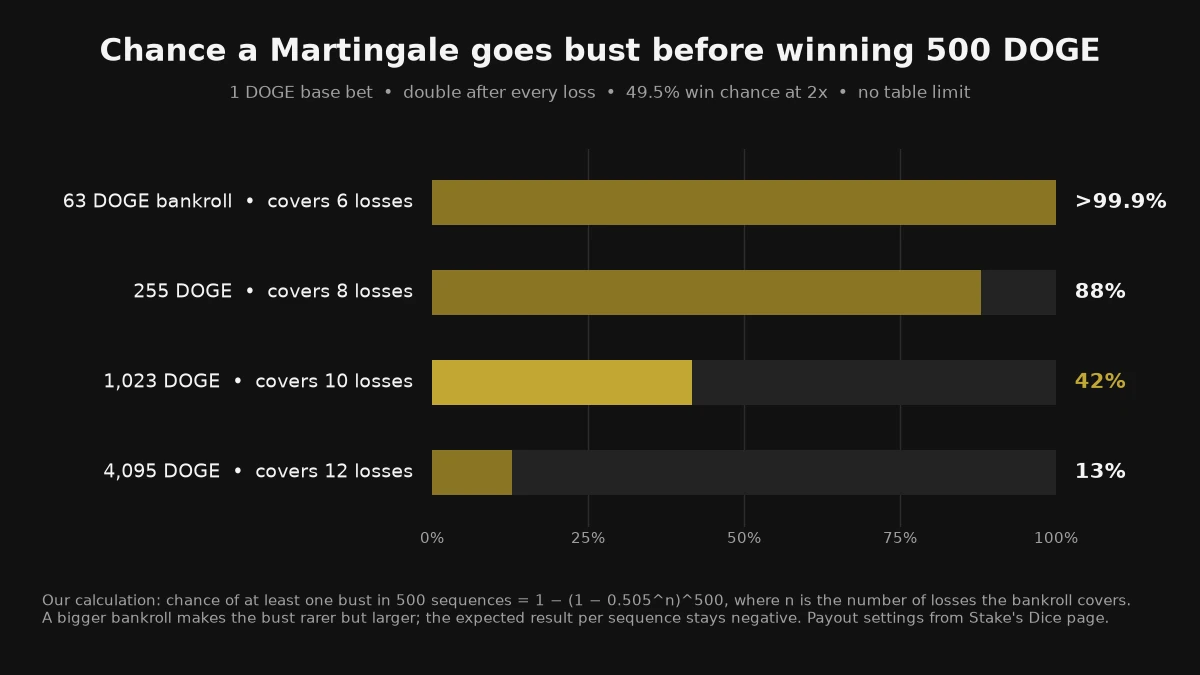
Here is our own calculation for a 1-DOGE Martingale at a 49.5% win chance and 2x payout. Each successful sequence wins 1 DOGE. A bankroll of 1,023 DOGE covers 10 losses in a row (1 + 2 + 4 … + 512). The chance of losing 10 in a row is 0.505 to the power of 10, about 0.11%.
That sounds safe, but trying to win 500 DOGE means 500 sequences. Our calculation gives these chances of hitting the losing streak at least once:
- 63 DOGE bankroll (6 losses covered): over 99.9%
- 255 DOGE (8 losses): about 88%
- 1,023 DOGE (10 losses): about 42%
- 4,095 DOGE (12 losses): about 13%
A bigger bankroll only makes the bust rarer and larger. The expected result per sequence stays negative, and a casino’s maximum bet can stop the doubling even sooner. A 2014 r/dogecoin thread reached the same conclusion with early Doge dice sites: rare wipe-outs cancel all the small wins.
How to play Dogecoin dice, step by step
- Check that you’re allowed to play. You must be 18 or the higher legal age where you live. Stake’s terms (clause 14.3) list the United States and the United Kingdom among prohibited jurisdictions, and 7Bit’s terms restrict them too.
- Pick a casino that confirms native DOGE. Stake, for example, accepts Dogecoin on the native Dogecoin network only.
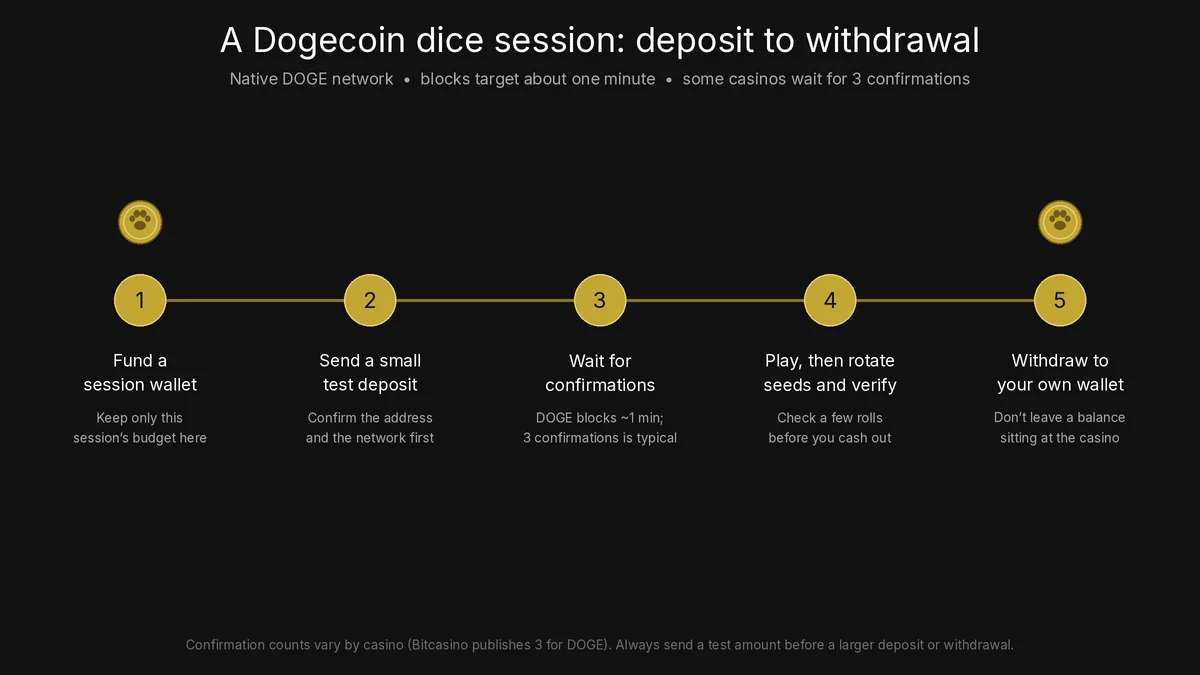
- Fund a small session wallet. Keep your dice budget in a separate hot wallet, as in our Dogecoin wallet for gambling guide, and send a small test deposit first.
- Set your own client seed and note the hashed server seed before the first roll. Our explainer on how server seeds, client seeds and nonces work covers why.
- Choose a win chance and a flat bet size. A higher chance gives smaller, steadier results; a lower chance gives bigger swings. The edge is the same.
- Set stop limits before auto-bet. Use a loss limit, a win target and a maximum number of rolls, and stop when one is hit.
- Rotate seeds, verify, then withdraw. Check a few rolls, then cash out to your own wallet. Our guide to how long a Dogecoin casino withdrawal takes explains the wait.
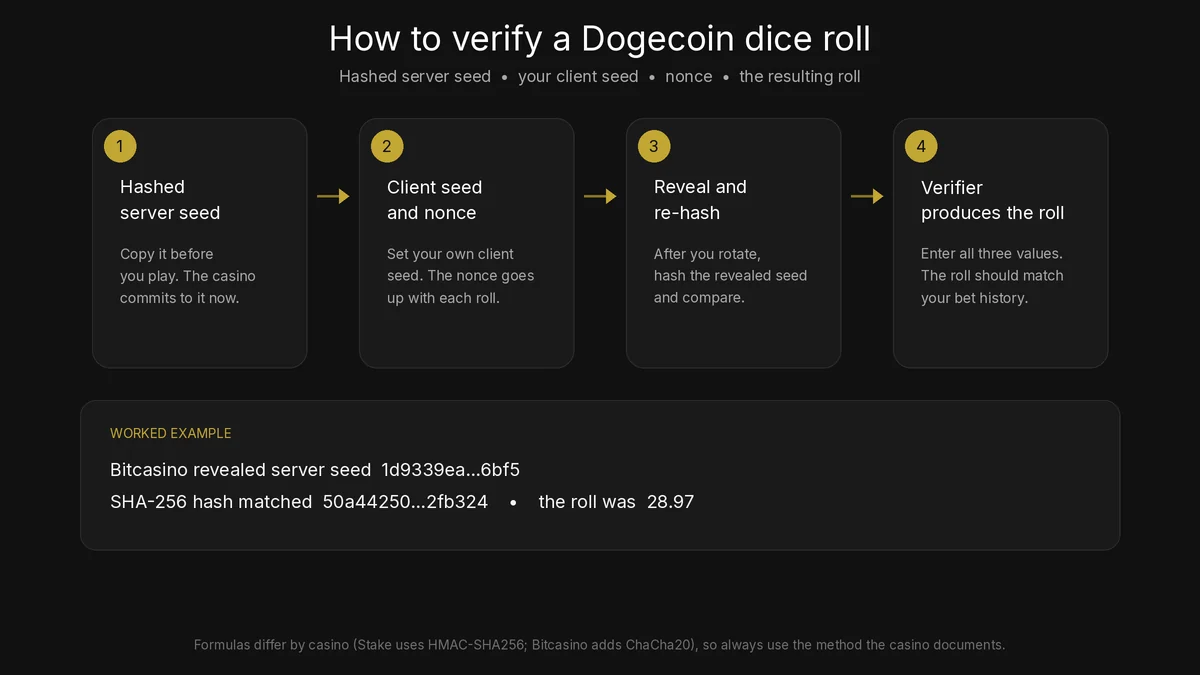
How to verify a Dogecoin dice roll
Bitcasino’s help page publishes a worked Dice example with a revealed server seed, a client seed and nonce 1. We reran its first check ourselves. Hashing the revealed server seed 1d9339ea…6bf5 with SHA-256 gave 50a44250…2fb324, the exact hash Bitcasino says was shown before the round. That match proves the seed wasn’t swapped after the bet. Bitcasino’s generator then produces 2897, so the roll is 28.97, and a bet on over 50.00 loses.
At your own casino, the process is the same:
- Copy the hashed server seed before you play.
- After rotating, hash the revealed seed and compare.
- Enter the server seed, client seed and nonce into the casino’s verifier or an independent tool, and confirm the roll matches your bet history.
Formulas differ between casinos. Stake uses HMAC-SHA256 and Bitcasino adds a ChaCha20 generator, so always use the method the casino documents.
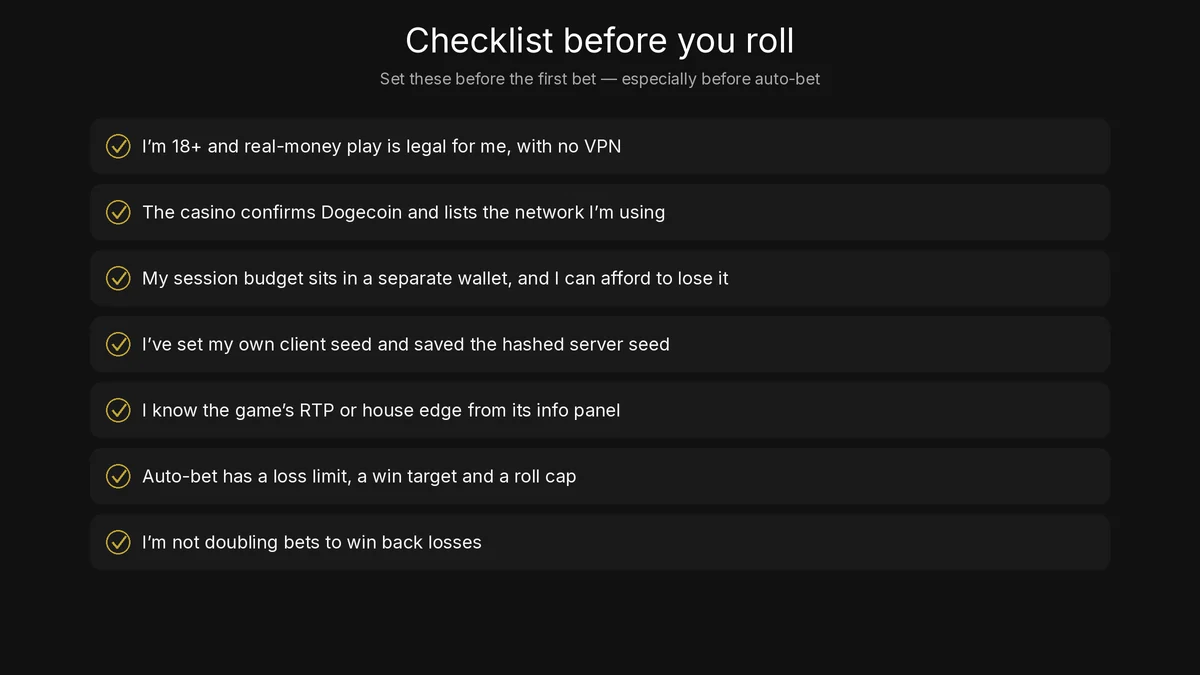
Checklist before you roll
- I’m 18+ and real-money play is legal for me, with no VPN.
- The casino confirms Dogecoin and lists the network I’m using.
- My session budget sits in a separate wallet, and I can afford to lose it.
- I’ve set my own client seed and saved the hashed server seed.
- I know the game’s RTP or house edge from its info panel.
- Auto-bet has a loss limit, a win target and a roll cap.
- I’m not doubling bets to win back losses.
Where to play Dogecoin dice
These casinos confirm Dogecoin on their own pages and offer dice. Check the RTP in each game’s info panel, because third-party titles can differ from in-house ones.
Disclosure: some links on this page are affiliate links, and we may earn a commission at no cost to you.
| Casino | Dice game | Published odds | Fairness | DOGE detail |
|---|---|---|---|---|
| Stake | Stake Dice (in-house original) | 99% RTP, 1% house edge | Provably fair | Native Dogecoin network only |
| Bitcasino | Dice (Bitcasino Originals) | Up to 49.5x, per Partners.io; RTP in game | Provably fair, built-in verifier | 3 confirmations for DOGE |
| 7Bit Casino | Third-party dice, such as Spribe’s Dice | Check each game’s info | Provably fair dice listed | DOGE in deposits, withdrawals and promotions |
Game availability can vary by region. For licences, game libraries and how these brands compare overall, see our best Dogecoin casinos guide.
Frequently asked questions
How do you play Dogecoin dice?
Deposit DOGE at a casino that accepts it, open its dice game, enter a bet, pick a target number and choose roll over or under. The game shows your win chance and multiplier before the roll. A roll in your range pays the multiplier.
What is the house edge on Stake Dice?
Stake’s Dice page lists a 99% return to player, which is a 1% house edge. The edge is built into the multiplier, 99 divided by your win chance, so it stays the same whatever target you choose.
What is the best strategy for winning at dice?
No strategy beats the house edge. The best approach is flat bets you can afford, a loss limit and a win target set in advance, and stopping when either is hit. Systems only change how often you win and how big losses get.
Is the Martingale strategy successful?
Not over time. Martingale wins small amounts often but eventually hits a losing streak that wipes out the bankroll or reaches the table limit. In our 1-DOGE example, a 1,023 DOGE bankroll has about a 42% chance of busting before winning 500 DOGE.
Can you earn real money playing dice?
You can win in a single session, but the house edge means you should expect to lose over time. Treat dice as paid entertainment, never as income, and only play with money you can afford to lose.
Play responsibly
Gambling is entertainment, not a way to make money. You must be 18 or older, or the higher legal age where you live, and it must be legal for you to play. Many crypto casinos don’t accept players from the United States, the United Kingdom and other countries, and you should never use a VPN or false details to get around that. Dice is fast, so set a budget and time limit before each session and never chase losses. If gambling stops being fun, take a break and reach out to Gamblers Anonymous or call 1-800-GAMBLER in the US.